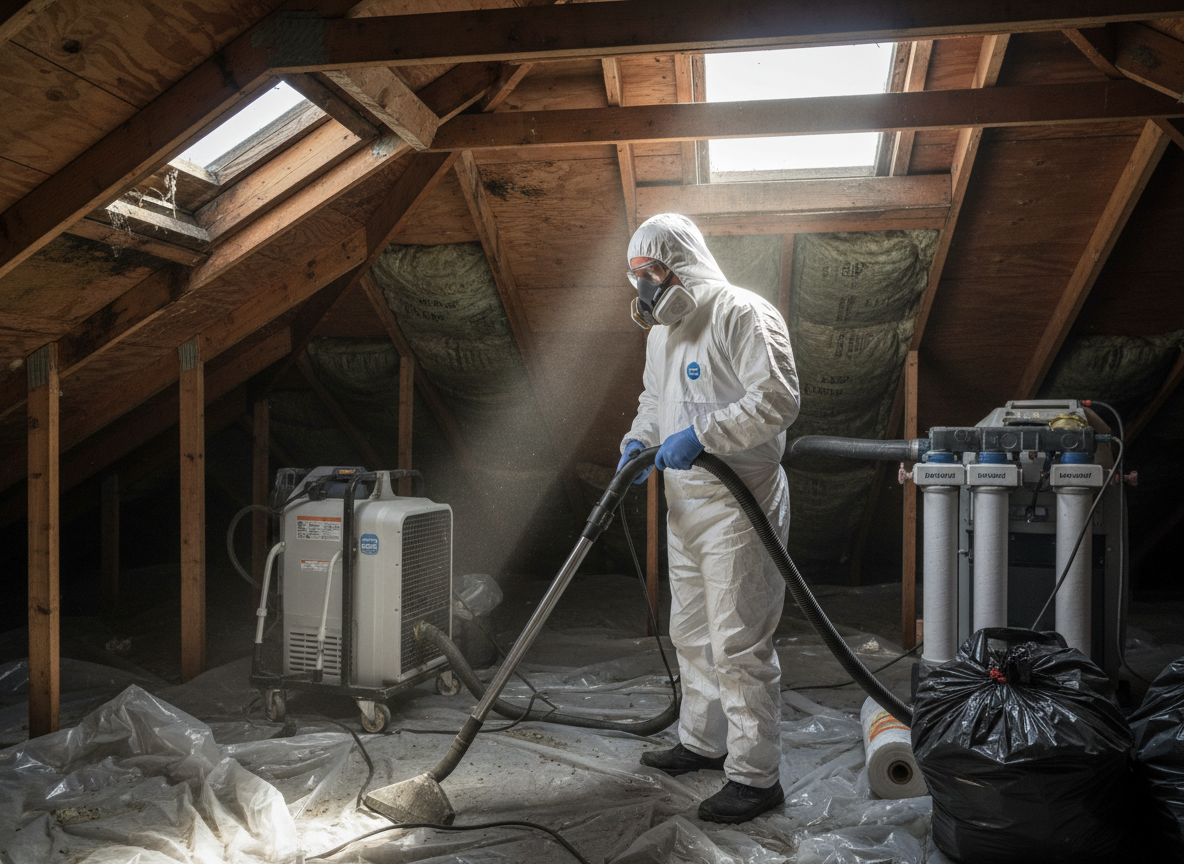
Sunset Beach sits in a mild coastal Mediterranean climate where cool summers still bring persistent marine layer humidity that infiltrates attic spaces through ridge vents and older composition shingles common on 1950s-1970s beach cottages. Once moisture lingers above fiberglass batts or cellulose insulation, mold colonies establish on roof sheathing and rafters within weeks. Remediation requires negative-air containment to prevent spores from migrating into living spaces below, followed by HEPA vacuuming and antimicrobial application on wood surfaces without damaging original framing.
Access challenges arise in these narrow lots where attic entries are often tucked behind knee walls or above laundry rooms in single-story homes near Pacific Coast Highway. We remove only the minimum insulation needed to reach affected areas, then reinstall with proper vapor retarders suited to Orange County’s salt-air environment. Edge cases include mold growth on HVAC ducts that run through unconditioned attics, where condensation lines must be insulated and sloped correctly to avoid repeat issues after remediation.
Local building practices in Sunset Beach frequently leave minimal attic ventilation compared to modern codes, so we document existing vent ratios and advise homeowners on code-compliant additions that do not alter the low-profile beach aesthetic. Hidden leaks from bathroom exhaust fans venting directly into attics rather than through the roof are a recurring trigger; addressing the source prevents recurrence before any surface treatment begins.
Seasonal Considerations
Marine layer moisture peaks in late spring and early summer, extending drying times for wood members after mold removal. Winter storms can push wind-driven rain under eaves, so inspections focus on north-facing roof planes first.
Technician insight
In Sunset Beach, the thing that catches most people out with attic mold remediation is how the constant salt air from the nearby ocean speeds corrosion on metal HVAC ducts once moisture sits in the insulation; we always pull back the ducts first to check for hidden growth along the seams.
Ocean-Side Cottage Attic
A Sunset Beach homeowner reported a musty smell after winter rains. Inspection revealed wind-driven moisture entering through an aging ridge vent near the beach. We contained the attic, removed wet cellulose, treated the rafters, and rerouted a bathroom exhaust fan that had been dumping humid air inside. Follow-up testing showed spore levels returned to normal.
How it works
- 1
Initial Assessment
Technician inspects attic access points, tests moisture levels in sheathing and insulation, and identifies the water intrusion source while containing the work area.
- 2
Containment and Removal
Negative air machines isolate the attic; affected insulation and porous materials are bagged and removed, followed by HEPA surface cleaning of rafters and sheathing.
- 3
Antimicrobial Treatment
EPA-registered solutions are applied to wood surfaces, with extra attention to areas near HVAC ducts common in Sunset Beach homes.
- 4
Drying and Verification
Dehumidifiers and air movers reduce moisture content below 12 percent; post-treatment air sampling confirms clearance before insulation reinstall.
- 5
Prevention Recommendations
Report includes suggestions for improved ridge vent balance and proper bathroom fan routing suited to coastal humidity patterns.
Pricing
Cost depends on attic size, extent of insulation removal, and whether HVAC components require separate treatment.